Watching Droplets Deform Before They Break: A Mesoscale Look Inside Homogenisation
Executive Summary
Homogenisation is one of the most mature unit operations in food and dairy processing, and one of the least visible. What actually happens to a fat droplet in the microseconds it spends inside the valve or slit is still mostly inferred, not observed.
We ran a set of particle-based simulations to see whether that gap is closeable. Soft elastic granules, standing in for droplets, were advected through a narrow constriction under realistic flow conditions, and their deformation was tracked from approach to exit.
The result: deformation behaviour that is consistent, repeatable, and interpretable, not just for one droplet but across multiple droplets and resolutions. And it ran in about an hour on four CPU cores.
RoseWorks specialises in simulation-based diagnosis of food and bioprocesses.
If your process involves droplets, particles, or soft inclusions moving through constrictions, shear zones, or valves, this kind of mesoscale view can turn "we think this is what's happening" into something you can actually see and compare.
We can also advise on your digital strategy, and whether dedicated simulation earns a permanent place alongside your lab and pilot-plant work.
Why the mesoscale is the blind spot
Homogenisers are everywhere in dairy, sauces, and emulsified formulations, and the equipment itself is well understood. What's poorly understood is the intermediate scale (roughly 1 micron to 1 millimetre) where a droplet actually deforms and, sometimes, breaks up.
That scale is difficult to access experimentally: it happens too fast, and too deep inside closed hardware, for direct observation. In practice, most plants and formulators end up relying on empirical tuning: adjust the valve, run the trial, measure the output distribution, repeat.
The question we wanted to answer is a practical one: can a simulation resolve what a droplet experiences mechanically as it transits a constriction, in a way that's fast enough and consistent enough to actually inform decisions before you commit to a physical trial?
The approach
We built a simplified analogue of a homogenisation-type flow: a piston-driven channel narrowing to a 100-micron slit, generating the same combination of rapid acceleration, strong confinement, and high shear you'd find in real equipment, without tying the geometry to any one specific valve design.
Soft elastic granules, standing in for droplets, were suspended in the carrier fluid and pushed toward the constriction. We deliberately left out interfacial physics, breakup, and surface tension at this stage, so the mechanical forcing on the droplet could be isolated and understood on its own before adding the complexity that governs whether and where it actually breaks.
The method itself, Smoothed Particle Hydrodynamics (SPH), represents both the fluid and the soft inclusions as particles rather than a fixed mesh, which makes it well suited to large deformation. It's the same particle-based framework we've used previously for extrusion with inclusions, run here on the RoseWorks platform.
What a single droplet does
Before adding complexity, we tracked one granule through the slit in isolation. The behaviour was distinctive and, importantly, physically sensible: the granule elongates parallel to the flow as it approaches the constriction, reaches peak deformation, and then reorients sharply, elongating orthogonal to the flow as it exits into the downstream jet.
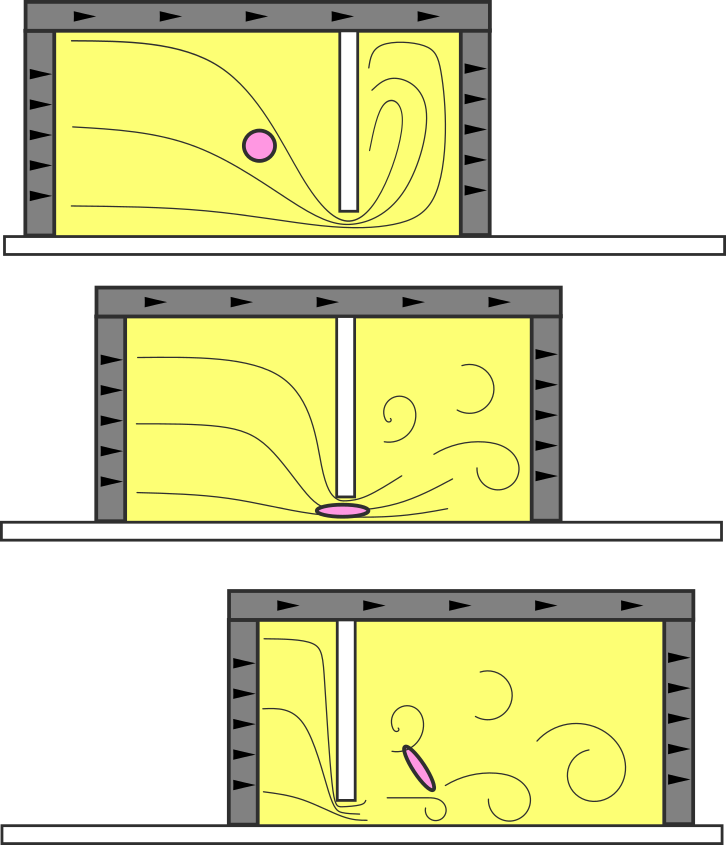
That reorientation shows up as a distinctive two-peak signature in the deformation history, a signature that turns out to matter a lot once we started asking whether it was reproducible.
Does it hold up with more than one droplet, and does resolution matter?
A single well-behaved simulation is a nice demonstration. It isn't proof the method is reliable. So we repeated the test with four granules simultaneously, and again at higher particle resolution, to check for two things: does deformation stay consistent when droplets can interact and disturb each other's local flow, and does the answer change if we refine the mesh?

The peak deformation values landed in a tight, consistent band across every granule and both resolutions, yielding roughly the same "how much did it stretch" answer, run after run. The higher-resolution case shifted the numbers up slightly but told the same story. That's the result that matters most for decision-making: the qualitative and quantitative picture doesn't depend on which granule you look at, or how finely you resolve it.
The part leadership actually asks about: is it fast and cheap enough to use?
Every one of these simulations (pure fluid, single granule, four granules, and four granules at higher resolution) ran in roughly an hour, on four CPU cores. Adding granules cost almost nothing extra in runtime; even the highest-resolution four-granule case only added about fifteen minutes over the baseline.
That matters more than it might sound. It means systematic exploration (different flow conditions, different droplet stiffness, different granule counts) is something you can realistically run as a screening step on modest hardware, not a specialist HPC undertaking. That's the difference between a one-off academic demonstration and a tool that fits into an actual R&D workflow.
What this does and doesn't tell you yet
To be direct about scope: this framework does not yet predict droplet size distributions, and it doesn't include surface tension, breakup, or coalescence. It's not a replacement for full industrial-condition modelling. There's also a known, non-physical void artifact that can appear near the slit tip in strongly accelerated regions. This is a recognised limitation of this class of particle method, and one we already know how to substantially reduce in follow-up work.
What it does do is resolve the mechanical precursor to breakup (the deformation history a droplet actually experiences) with repeatable, interpretable results, at a computational cost that fits inside a normal project timeline. That's the layer that's been hardest to observe directly inside real equipment, and it strongly conditions everything that happens to the droplet afterward.
Where this goes next
The immediate next steps are to check this deformation response against known analytical and experimental reference cases, extend the same approach into 3D, and move toward more rigorous local strain-rate estimates. Once that foundation is in place, adding surface tension is what turns this from "tracking deformation" into "predicting whether and where breakup happens." This is a direct input to droplet-size estimation, and ultimately a tool for connecting valve geometry, pressure, and formulation to measurable product attributes.
The long-term goal is straightforward: reduce how much of process transfer, scale-up, and troubleshooting still depends on empirical tuning. This work shows the first layer of that (resolving the mesoscale mechanics) is already tractable today.
If your team is wrestling with an emulsification, extrusion, or constricted-flow process where the mechanism is more "black box" than you'd like, we'd welcome the conversation.
Footnotes and comments
- Full technical detail, including geometry, material parameters, numerical settings, and the underlying Taylor deformation analysis, is available in the associated brief: Jenkinson, W. (2026), "Resolving Droplet-Scale Deformation in a Homogenisation-Inspired Flow: A Mesoscopic Particle Method Demonstration," RoseWorks.